




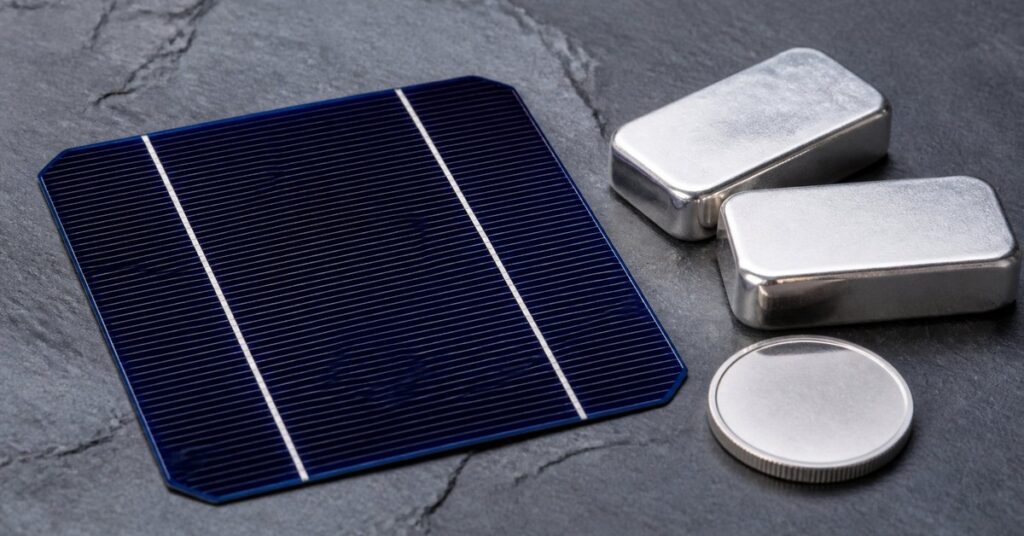
For years, the investment case for silver has been closely linked to the green-energy transition. Solar panels need it. Electric vehicles use it. Electrification, data centres, consumer electronics and grid investment all require it. As governments and businesses spend more on renewable energy and technology, the assumption has been that silver demand can only move in one direction.
The latest market forecasts tell a more complicated story. Silver demand from the solar sector is expected to fall sharply this year. Overall industrial demand is also forecast to decline. Yet the silver market is still expected to record a deficit for the sixth consecutive year. That is not a contradiction. It is a warning about how tight the underlying market remains.
The solar story is changing
Solar power has become one of silver’s most important industrial-demand narratives. Silver is used in photovoltaic cells because it is the most conductive metal, helping convert sunlight into electricity efficiently. However, solar-panel manufacturers have a strong incentive to reduce the amount of silver used in each cell, particularly when the silver price rises. This process, often referred to as thrifting, has become increasingly important.
The World Silver Survey 2026 forecasts that photovoltaic demand will fall by 19% this year to around 151 million ounces. That follows a fall in 2025, when solar demand declined by approximately 6% from the previous year’s record level. This does not mean that solar power has stopped growing or that silver is no longer important to the sector. It means that expanding solar installations do not automatically translate into a similar increase in silver consumption. Manufacturers are using technology, improved efficiency and material substitution to reduce their exposure to higher silver prices.
That is an important distinction for investors. The old argument — more solar panels must mean more silver demand — is too simplistic.
The deficit remains
Despite weaker expectations for solar demand, the silver market is forecast to remain in deficit by 46.3 million ounces in 2026. That would be a larger shortfall than the 40.3-million-ounce deficit recorded in 2025, and it would mark the sixth consecutive year in which global silver demand exceeds supply. Forecast total demand is expected to fall by around 2% this year, to roughly 1.113 billion ounces. Total supply is forecast to decline by around 2%, to 1.066 billion ounces. Mine production is expected to be broadly stable to slightly lower, whilst increased recycling is not expected to fully offset the reduction in total supply.
The market therefore remains short. Not because every category of demand is accelerating, but because supply still cannot comfortably meet the demand that remains. That is the point investors should focus on. A deficit does not mean that the world will suddenly run out of silver. Above-ground stocks exist, exchange inventories can move and recycled material can re-enter the market. But repeated deficits have to be met from somewhere. Over time, they reduce the cushion available when industrial demand rises, investment buying accelerates or supply is disrupted.
Silver supply cannot react quickly
Silver is different from many commodities because much of the world’s supply is not produced by dedicated silver mines. A substantial amount comes as a by-product of mining for lead, zinc, copper and gold. That means a higher silver price does not necessarily lead to a rapid increase in output. A producer operating a copper or zinc mine may benefit from higher silver revenues, but its investment decisions will still be driven primarily by the economics of copper or zinc.
In other words, silver miners cannot simply turn on production because the market needs more ounces. New mines take years to permit, finance and develop. Existing mines face declining grades, rising energy and labour costs, political risk and increasingly complex regulation. Recycling can help fill part of the gap, but it is not an unlimited or immediate answer, particularly for silver used in electronics and industrial applications where recovery can be uneconomic. This is why a modest annual deficit can matter. The silver market does not have a quick, reliable mechanism for creating a large increase in supply.
Investment demand is returning
There is another reason the deficit has persisted: physical investment demand is expected to strengthen. Coin and bar demand is forecast to rise by 18% in 2026, reaching its highest level since 2022. That matters because investment buying competes for the same physical metal used by industry. A solar manufacturer, electronics producer and private investor are not necessarily buying the same product or through the same supply chain, but they are all ultimately drawing from the same global pool of refined silver.
Silver is also a much smaller market than gold. It can therefore respond more sharply when investment demand changes direction. That brings opportunity, but it also brings considerable volatility. Silver’s recent price movements have underlined that it can rise quickly when demand is strong and retreat just as quickly when investors take profits or economic concerns reappear. For investors, this is the balance to understand. Silver has a genuine structural-demand case, but it is not a simple or risk-free one.
The real silver story
Silver should not be viewed as a one-dimensional solar trade. The sector remains important, but projected reductions in photovoltaic silver use show that the market can adapt. Technology may reduce the amount of silver needed per solar cell, even while total solar capacity continues to expand.
The more important point is that silver supply remains constrained at a time when industrial demand is still historically significant and physical investment demand is recovering. Even with overall demand forecast to dip slightly in 2026, the market is expected to remain short by more than 46 million ounces. That is why silver remains compelling. Not because every demand forecast is rising. Not because solar panels alone will force prices higher. But because the market has spent six consecutive years consuming more silver than it produces — and there is still no easy way for supply to close the gap.
