




Platinum has experienced a volatile year. Following a powerful rally, the metal has pulled back from its earlier highs, reminding investors that even a market with a compelling long-term supply story can move sharply in both directions.
For investors considering platinum, the recent price chart is important. However, it should not be the only thing they look at. Price movements can be driven by short-term positioning, profit-taking and changes in investor sentiment. The more useful questions are whether physical supply is expanding, how industrial demand is changing, how much metal remains available above ground and whether the automotive market is becoming more or less supportive. The answers are more nuanced than the latest headline suggests.
A Pullback Does Not Settle the Debate
A sharp rally often attracts new investors, particularly once prices begin to receive wider media attention. But it can also lead to profit-taking, especially where buyers who entered earlier decide to lock in gains. That is one reason platinum’s price performance cannot be judged simply by looking at whether it is rising or falling on a particular day. The World Platinum Investment Council’s latest quarterly update illustrates this well. It now expects the platinum market to record a surplus of 265,000 ounces in 2026, a significant change from its previous forecast of a 297,000 ounce deficit.
On the surface, a move from expected deficit to surplus might appear negative for platinum. However, the detail behind that change matters. The projected surplus is not primarily the result of a major increase in mine production. WPIC says the revision from a forecast deficit to a surplus is almost entirely due to a substantial reduction in expected investment demand, driven by ETF and exchange-stock outflows in the first half of 2026. Weaker jewellery demand and higher recycling also contribute to the full year balance. Total mine supply is expected to remain broadly flat in 2026. This is an important distinction. A surplus caused by investors selling metal into the market is very different from one caused by a large and sustained increase in primary mine supply.
Investment Flows Can Move the Market Quickly
Platinum is a relatively small market compared with gold. This means changes in investment flows can have an outsized influence on the short-term balance between supply and demand. In the second quarter of 2026, the platinum market recorded a surplus of 244,000 ounces. The largest factor was ETF outflows of 234,000 ounces, with the market recording net disinvestment of 121,000 ounces over the quarter. ETF selling does not mean that platinum has suddenly lost its industrial role or that mine supply has become abundant. It simply means that investors were reducing exposure at that point in time.
This matters because investment demand can be volatile. It can reverse quickly if investors become concerned about inflation, currency weakness, geopolitical uncertainty, industrial supply disruption or renewed tightness in the physical market.
The latest WPIC forecast expects net investment disinvestment of 83,000 ounces for the full year. It also expects ETF inflows in the second half of the year, although not enough to fully offset the large outflows seen earlier in 2026. For platinum investors, this highlights a useful lesson: the market balance can change materially when investment sentiment shifts, even if the underlying mining picture remains largely unchanged.
Above-Ground Stocks Remain Limited
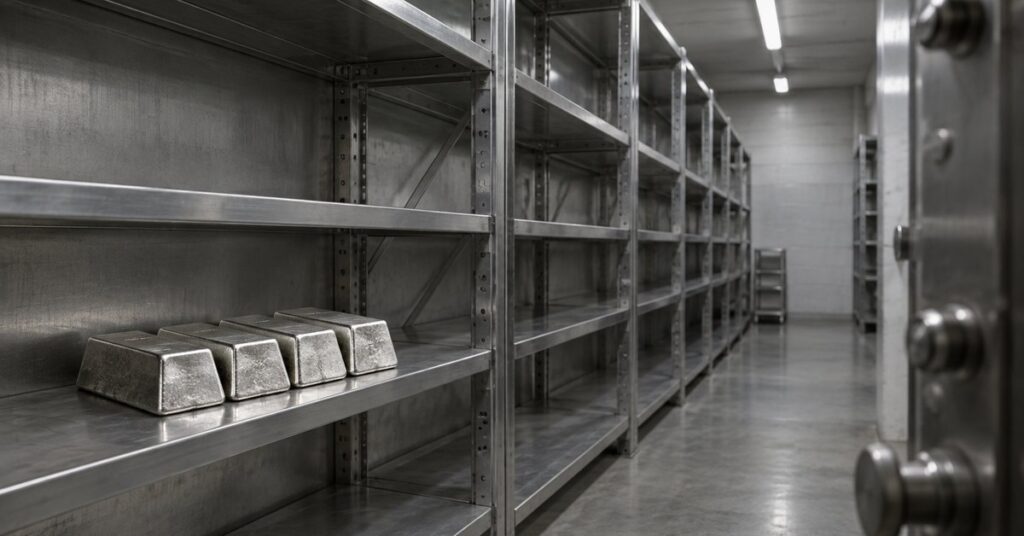
One of the most important factors in the platinum market is not always visible on a price chart: the amount of metal that remains available above ground. The 2026 surplus follows three consecutive years of meaningful deficits. In fact, WPIC has revised its estimate of the 2025 platinum deficit higher to 1.44 million ounces which would represent its largest annual deficit since 2013. Even with a forecast surplus this year, above-ground platinum stocks are expected to stand at around 2.01 million ounces by the end of 2026. That is equivalent to only around 3.4 months of global demand cover.
This does not mean that there is an immediate shortage of platinum bars or coins. Nor does it guarantee higher prices. However, it does mean that the market has less room to absorb an unexpected disruption than it might have had in previous years. A prolonged power problem in South Africa, a mine stoppage, a disruption to Russian supply or a sharper-than-expected recovery in investment demand could have a greater effect in a market where inventories are already lean.
Mine Supply Is Not Expanding Rapidly
Platinum supply is geographically concentrated, with South Africa responsible for the majority of primary mine production. Russia and Zimbabwe are also important sources.
Mining is capital-intensive, energy-intensive and slow to expand. New platinum-group metal projects require significant investment, long lead times and confidence that prices will support future production. This means supply does not typically respond quickly to a higher price.
WPIC expects total platinum supply to rise by 2% in 2026 to 7.35 million ounces. However, this growth is expected to come primarily from recycling, which is forecast to rise by 8% to 1.80 million ounces. Primary mine supply is expected to remain broadly unchanged at around 5.55 million ounces. Recycling can help meet demand, particularly when higher prices encourage the recovery of metal from old catalytic converters and industrial materials. But it does not provide the same long-term supply response as a sustained increase in mining output. For investors, that makes it important to separate total supply from mine supply. A short-term increase in recycling can ease the market balance, but it does not necessarily solve the structural challenge of limited new primary production.
Automotive Demand Still Matters
The motor industry remains platinum’s largest individual source of demand. Platinum is used in catalytic converters, where it helps reduce harmful emissions from internal-combustion and hybrid vehicles. The rise of battery-electric vehicles is therefore a long-term challenge. Fully electric vehicles do not have an exhaust system and do not require a catalytic converter. However, the change is not immediate. Hybrid vehicles still require catalytic converters, and petrol, diesel and hybrid cars will remain a substantial part of the global vehicle fleet for years to come. Tighter emissions standards can also increase the amount of platinum-group metals required in each qualifying vehicle.
For 2026, WPIC expects automotive platinum demand to decline by 4% to 2.90 million ounces. This is a reduction, but not a collapse. The automotive outlook should therefore be viewed in context. Electric-vehicle growth is a genuine long-term headwind, but the transition is uneven across countries and vehicle types. In the meantime, demand from conventional and hybrid vehicles remains significant.
Industrial Demand Offers Support
Platinum is not only an automotive metal. It is used in chemical processing, petroleum refining, glass manufacture, electronics, medical equipment and a range of specialist industrial applications. This broader industrial base is one reason platinum cannot be assessed solely through the outlook for diesel vehicles or electric-car sales. Industrial platinum demand is forecast to rise by 5% in 2026 to around 2.38 million ounces. In the second quarter alone, industrial demand increased by 6% year on year to 600,000 ounces. Some industrial uses are cyclical and will be affected by global economic growth. Others are linked to long-term investment in manufacturing capacity, energy infrastructure and technology.
Hydrogen remains another area of interest. Platinum can be used in fuel cells and electrolysers, and demand from hydrogen-related applications is expected to grow over time. However, it remains a developing market and should not be treated as an immediate replacement for automotive demand. The near-term platinum story remains far more closely tied to established industrial and vehicle uses.
Jewellery and Chinese Demand
Jewellery demand is another factor that has affected platinum’s market balance this year. Higher prices and weaker demand in China contributed to a sharp decline in platinum jewellery demand during the second quarter. WPIC reported a 32% year-on-year fall to 456,000 ounces during the period.
This demonstrates how quickly demand can change once a precious metal becomes more expensive. Consumers may delay purchases, choose lower-weight pieces or move towards alternative metals. It also shows why a strong price alone is not always a sign of a stronger market. Rapid price increases can eventually weaken demand from jewellery buyers, investors and industrial users. This is particularly true if those users have the ability to defer purchases, redesign products or draw down existing inventories.
What the Price Chart Cannot Show
The platinum chart can tell us what investors have recently been willing to pay. It cannot, by itself, tell us why. A pullback may reflect profit-taking after a strong move. It may reflect ETF selling, weaker jewellery demand, lower expectations for car production or wider uncertainty about economic growth. It does not automatically tell us that the underlying supply position has become comfortable. Equally, tight above-ground stocks do not guarantee that platinum will rise immediately. The market still faces real challenges: reduced automotive demand over time, a developing rather than mature hydrogen market, volatile investment flows and the possibility of higher recycling when prices are elevated.
For that reason, platinum is best viewed as a market with both opportunities and risks.
The key factors worth monitoring are:
– The level of above-ground inventories.
– South African mining output and power reliability.
– Recycling volumes from old catalytic converters.
– ETF holdings and wider investment flows.
– Automotive production, particularly hybrid-vehicle demand.
– The pace of battery-electric vehicle adoption.
– Industrial demand from chemical, glass, technology and hydrogen-related sectors.
– The price relationship between platinum and palladium.
A More Balanced View of Platinum
The recent pullback should not be ignored, but neither should it be treated as the whole story. The latest forecast points to a modest platinum surplus in 2026. Yet that surplus follows three deficit years, including a revised 1.44-million-ounce deficit in 2025, and it is expected to leave above-ground inventories at only around 3.4 months of demand. At the same time, the projected surplus is heavily influenced by investment outflows and higher recycling rather than a major expansion in mine production. Industrial demand is still expected to grow, while automotive demand, though lower, remains.
For investors, the lesson is simple: do not make a decision based solely on a chart.
Platinum can be volatile, and short-term price moves should be expected. But a proper assessment should consider the physical market, the supply chain, industrial demand, investment flows and the amount of metal actually available to meet future demand.
The price tells part of the story. The market underneath it tells the rest.
