




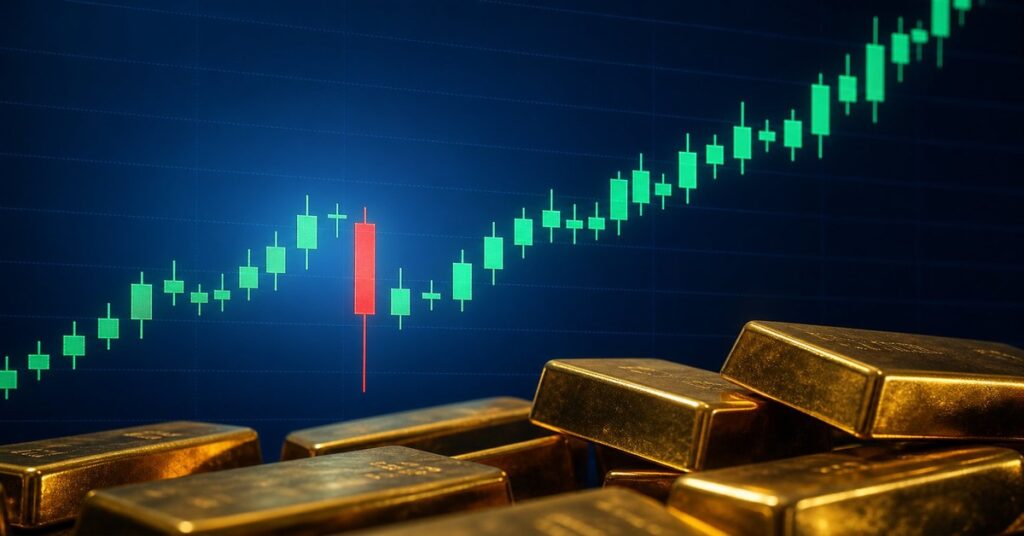
Gold’s price can sometimes fall by £200 or more in a single day, which looks terrifying if you only glance at the headlines. Yet those same moves can happen right in the middle of a strong, ongoing bull market. Understanding why helps investors stay calm, avoid emotional decisions, and see sharp drops in context rather than as a reason to panic.
Bull markets are about trend, not single days
A bull market is defined by a pattern of higher highs and higher lows over time, not by what happens on any one day. Gold can advance hundreds or even thousands of pounds over a multiyear period while still experiencing occasional violent pullbacks along the way. A £200 daily swing may look dramatic, but as prices rise, “normal” volatility grows in absolute terms as well.
Think of it this way: when gold was £800 an ounce, a £40 move felt big. At £4,000, an equivalent percentage move is £200. The numbers have got larger, but the percentage move is similar. What matters is whether the broader uptrend remains intact—whether, after the dust settles, prices are still making higher lows and buyers continue stepping in on dips.
Leverage and shortterm traders amplify moves
One of the biggest reasons gold can move so sharply in a single session is the presence of leveraged traders in futures and derivatives markets. Many hedge funds and speculative traders use borrowing or margin to amplify their positions. When sentiment shifts because of an economic data release, a central bank comment, or a sudden move in bond yields, those leveraged positions can be cut very quickly.
When enough players hit the “sell” button at once, it creates a fast, cascading effect. Stoploss orders are triggered, margin calls force exits, and algorithmic trading systems can accelerate the move. None of this has much to do with longterm investors or central banks; it is mainly shortterm positioning being unwound. Once that process burns through, the underlying demand for physical bullion often reasserts itself.
News shocks and data releases cause kneejerk reactions
Gold trades off expectations about interest rates, inflation and risk, so key economic data and centralbank announcements can cause instant repricing. A strongerthanexpected jobs report, a surprise rate decision, or a sudden easing of geopolitical tensions might trigger investors to reassess how much “safety” they want to hold.
These reactions are often exaggerated in the short term. Markets move first, analyse later. Traders might dump gold on the assumption that higher interest rates will hurt prices, even if the longerterm picture (such as persistent government debt or broader geopolitical risk) still supports owning bullion. Over days or weeks, prices frequently drift back toward where the underlying fundamentals would suggest.
Liquidity and timeofday effects matter
Gold trades around the clock, but not all hours are equal. During thinner liquidity periods such as the transition between major trading sessions or quiet holidays, a relatively modest order can move the price much more than usual. If a large sell order hits a thin order book, the price can gap down quickly as it seeks the next batch of willing buyers.
These sharp, lowliquidity moves can look frightening on an intraday chart but often reverse once deeper markets open and a wider pool of participants can respond. Longterm investors rarely make decisions based on what happens in a lowvolume tenminute window; they focus instead on weekly and monthly closes.
Physical demand and central banks don’t turn on a dime
Behind the noisy daily price action sits a slowermoving base of demand: longterm private investors, jewellery buyers, and central banks. These participants tend not to buy and sell on the basis of a single piece of data or a oneday move. Their decisions revolve around multiyear views on currency stability, inflation, diversification, and reserves management.
When the price falls sharply, this underlying demand can actually strengthen. Some buyers see a lower price as an opportunity to add to positions at a discount, especially if their longterm thesis for holding gold has not changed. It’s this steady, structural demand that defines a bull market—sharp drawdowns are often pauses or resets within that broader story, not the end of it.
Volatility is a feature of bull markets, not just bear markets
Many investors assume big down days mean the bull market is over. In reality, strong uptrends in any asset, whether shares, property or gold, often include some of the largest singleday declines. When prices have risen significantly, more profit is “sitting on the table,” which increases the incentive for traders to take gains and makes corrections larger in absolute terms.
In a bull market, pullbacks often serve to cool excessive optimism, flush out weak hands, and reset positioning. The key question is what happens next: does gold stabilise and find buyers at higher levels than previous bottoms, or does selling persist and start to break the pattern of higher lows? The answer to that pattern, not the size of one day’s candle, tells you whether the bull run is continuing or failing.
How longterm investors can respond to big down days
For a longterm holder, the main risk in a £200 daily drop is not usually the move itself, but the temptation to react emotionally. Selling into a panic can crystallise losses just as conditions are turning back in your favour. Instead, it can help to decide your approach in advance:
- Define your time horizon and reasons for holding gold—hedging, diversification, or longterm wealth preservation.
- Expect volatility in both directions and treat large down days as possible opportunities rather than automatic red flags.
- Use ranges and staged purchases instead of trying to catch one perfect entry price.
By framing daily moves within a bigger picture, investors are less likely to be thrown off course by inevitable bouts of volatility. A £200 drop can feel dramatic, but in a genuine bull market it is often just a sharp step along a much longer path upwards.
