




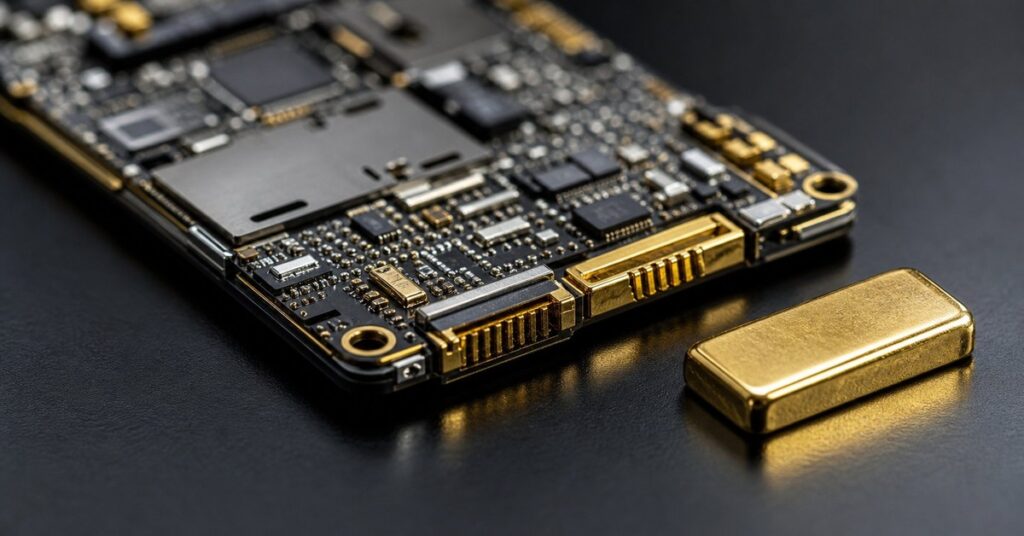
When most people think about gold and silver, they picture coins, bars, and perhaps jewellery. Yet the chances are you have already used both metals several times today without realising it. Far from belonging only in vaults and display cases, gold and silver are quietly working away inside the technology that keeps modern life moving.
In this article, we will look at some of the everyday devices and systems that depend on these metals, and why that matters for anyone thinking about them as a longterm store of value.
Why Technology Still Loves Gold and Silver
Gold and silver have been valued for thousands of years as money and decoration, but engineers prize them for different reasons. Both metals have physical properties that are hard to replace, even with modern materials science.
Silver is the best natural conductor of electricity and heat, which makes it extremely efficient in electrical contacts, circuits and heatspreading components. Gold is highly conductive too, but its main advantage is that it does not tarnish or corrode, even in harsh environments.
That combination – reliable conductivity plus resistance to corrosion – is why both metals appear wherever performance and reliability matter more than shaving off a tiny cost.
The Smartphone in Your Pocket
A good example is the smartphone you may be reading this on. Inside almost every modern phone, small amounts of gold and silver help carry signals, manage power and keep connections stable over years of use.
Gold is used in highreliability connectors, bonding wires and contact points on circuit boards, where any corrosion could lead to failures or data loss. Silver appears in solder, circuit traces and sometimes in specialist pastes and coatings that help manage heat and electrical performance.
Individually, each phone only contains a tiny fraction of a gram, but when you multiply that across billions of devices worldwide the usage becomes significant.
Inside Computers, Data Centres and The Cloud
The same principles apply at larger scale inside laptops, servers and datacentre hardware. Every time you save a file to “the cloud”, the information passes through equipment that relies on goldplated connectors and silverbased components to keep data moving accurately and quickly.
Highperformance connectors in network equipment often use gold plating for low resistance and longterm reliability. Silver is used in certain types of contacts, switches and thermal management materials that help take heat away from processors and power components.
For businesses and institutions, the cost of downtime is high, so designers tend to choose materials that give the best chance of years of troublefree operation.
Solar Panels and Renewable Energy
Silver in particular plays a wellknown role in solar power. In most modern photovoltaic panels, silver paste is used to form fine conductive lines that collect and carry the electricity generated by the solar cells. These silver “fingers” and busbars are chosen because they conduct current very efficiently without taking up too much space on the cell surface.
Researchers work continuously to reduce the amount of silver used per panel, but global installation of solar capacity has grown so rapidly that total silver demand from the sector has still become substantial over time.
This link between silver and renewable energy does not guarantee any particular price outcome, but it illustrates how industrial demand can sit alongside investment and jewellery demand.
Electric Vehicles and Modern Transport
As vehicles become more complex and more electric, they also become heavier users of certain precious metals. Electric vehicles (EVs) and hybrids can contain more silver than older, simpler cars because of the extra wiring, power electronics and control systems.
Silver is present in relays, switches, control modules and some forms of highperformance contacts throughout the vehicle. Gold may be used in specialised connectors and sensors where reliability and resistance to corrosion are critical over long service lives.
Even traditional petrol and diesel cars make use of precious metals in their electronics, though different metals such as platinum, palladium and rhodium play the key roles in exhaust treatment.
Medical Devices and Healthcare
Gold and silver also appear in various areas of healthcare technology. Their biocompatibility and stability make them attractive for specific uses inside and outside the body.
Gold is used in some implants, diagnostic equipment and specialist sensors, where its resistance to corrosion and reaction inside the body is essential. Silver’s antimicrobial properties mean it can be found in certain wound dressings, coatings and equipment designed to help reduce bacterial growth.
Again, the quantities involved per device are usually small, but they are chosen for specific properties that cheaper materials struggle to match.
Everyday Electronics and Household Items
Beyond the headline technologies, small amounts of gold and silver sit quietly in many of the devices around a typical home. From televisions and games consoles to washing machines and thermostats, any product with reliable electronic control may benefit from these metals in its connectors or contacts.
Remote controls, switches and relays can contain silver in their contacts for consistent performance over thousands of uses. Highquality audio and video equipment often uses goldplated connectors to maintain a clean signal path over time.
Most people will never see these details, but they rely on them every time they press a button or turn something on.
Why This Matters to Bullion Investors
For someone considering physical gold or silver coins and bars, industrial usage is only one part of the picture, alongside monetary history, centralbank policy and investor sentiment. However, understanding how these metals support everyday technology can make them feel less abstract than a simple chart of historical prices.
In gold’s case, industrial demand is smaller than its role as a store of value, but its reliability in demanding applications reinforces the idea of a metal that does not easily degrade or fail.
For silver, the combination of investment, jewellery and growing industrial uses – particularly in areas like solar power and electronics – is part of why some investors view it as both a precious and an industrial metal.
None of this removes price risk or guarantees returns, but it helps explain why these metals retain a role in the modern world even as technology races ahead.
