



As 2025 draws to a close, investors worldwide are evaluating the economic and political shifts that defined the year for precious metals. Once again, gold, silver, and platinum-group metals (PGMs) proved their worth as essential anchors in diversified portfolios. The market showed impressive resilience, supported by a “perfect storm” of relentless central bank buying, tightening supply lines, and a resurgence in industrial demand.
The Official Sector: Moving Away from the Dollar
If there was a single dominant narrative in the 2025 bullion market, it was the sheer scale of central bank accumulation. For the third year running, official sector net purchases remained a pillar of demand. Leading the charge were Poland, China, India, Turkey, and Kazakhstan, joined by several Middle Eastern nations quietly bolstering their reserves. This isn’t just about accumulating wealth; it is a strategic pivot away from the US dollar. Reserve managers are acting with geopolitical pragmatism, looking to insulate their nations from the risks tied to Western debt and volatile interest rates. With global debt surpassing $346 trillion in Q3 2025, corresponding to around 310% of global GDP, the argument for holding gold, an asset with no counterparty risk, has never been stronger. For the private investor, this institutional behaviour acts as a massive validation. Every ton of gold bought by a central bank serves as a reminder that the metal remains the ultimate insurance policy against policy error and fiscal instability.
The Supply Squeeze: Mining’s Hard Reality
While demand was robust, the supply side of the equation faced serious friction in 2025. Even with favourable prices, miners struggled with a trifecta of rising energy costs, labour shortages, and regulatory bottlenecks. Cash operating costs for gold producers jumped approximately 7% year-on-year, driven largely by steeper prices for diesel, steel, and cyanide. The situation was even tighter for PGMs. In South Africa and Zimbabwe—the global hubs for platinum production—output was hamstrung by aging infrastructure and unreliable electricity supply. Consequently, early data indicates global platinum supply dipped by an estimated 3%, pushing the market into yet another structural deficit. Palladium remained similarly constrained, with Russian exports still choked by sanctions and logistical barriers. Perhaps most concerning for the long-term picture is the lack of new supply coming online. The number of new gold mines starting production in 2025 hit a nearly ten-year low. After years of inflation, producers are prioritizing capital discipline over expansion, and permitting delays are dragging on. Analysts now warn that without major new discoveries, global mined gold supply could plateau within three to five years, a scenario that would significantly underpin the metal’s scarcity value.
Industrial Demand: Powered by Green Tech
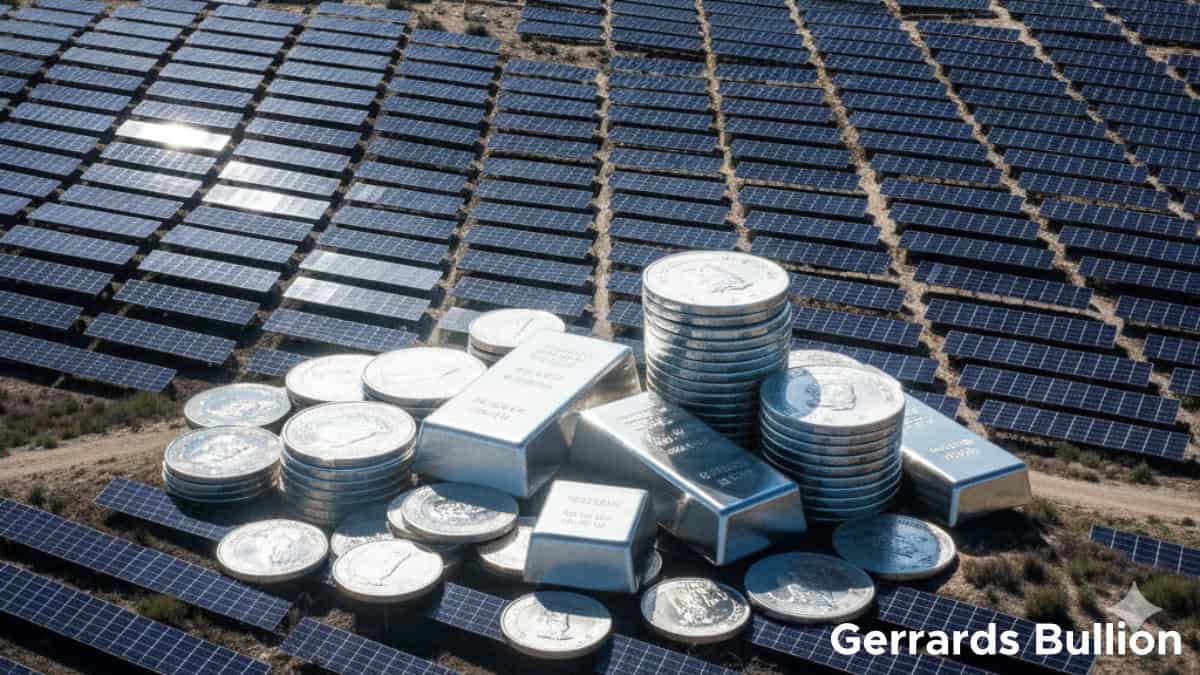
Silver and platinum were the clear industrial standouts of the year. As governments pushed harder on decarbonisation, solar energy capacity additions again set records, exceeding 650 GW, a significant jump from the roughly 600 GW seen in 2024. Since every megawatt of photovoltaic capacity can, in high-silver designs, use up to 25kg of silver, this boom kept industrial demand hovering near the all-time highs of over 600 million ounces seen in 2023. The electric vehicle (EV) sector also continued its march, clearing 18.5 million global sales by November, a 21% increase year on year. Silver’s unbeatable conductivity makes it indispensable for EV circuitry, battery connectors, and charging stations, effectively bridging the gap between an industrial necessity and a monetary asset. Platinum, meanwhile, saw renewed interest thanks to the hydrogen economy. Policy support advocated in Europe, Japan, and South Korea helped advance pilot projects for hydrogen transport and energy storage. While the sector is still nascent, demand from fuel-cell electric vehicle production is projected to hit 250,000 ounces annually by 2030, signalling a strategic future for the metal.
How Investors Are Positioning
Market behaviour evolved interestingly across both physical and digital channels this year. Demand for physical bullion bars and coins held steady at around 1,150 tonnes. While slightly off the exceptional highs of 2024, this is still well above the five-year average. The appetite for physical metal remained strongest in Germany, the UK, and China, where concerns over sticky inflation and currency devaluation drove retail buying. In the professional space, we saw a shift back into Exchange Traded Products (ETPs). Global gold ETFs attracted inflows of nearly 400 tonnes by mid-year, reversing the outflows seen in previous years. This suggests institutional investors are once again viewing precious metals as a core allocation rather than just a tactical trade. Technology is also widening the net. Tokenised gold products—digital tokens representing fractional ownership of vaulted bars—gained traction in hubs like London, Zurich, and Dubai. It remains a niche sector, but it highlights how the market is modernising to offer easier access to physical assets.
The Macro Backdrop: Living with Risk
The economic landscape underpinning these moves was one of persistent uncertainty. From flare-ups in the Middle East to ballooning Western debt, policy risk was a constant companion for investors in 2025. With the US fiscal deficit near 6% of GDP and debt-to-GDP ratios in Europe and Japan at record levels, questions about long-term monetary stability are back on the table. Equity markets were volatile, reacting to every shift in rate-cut expectations and uncertainty surrounding tariffs, while bodies like the IMF and BIS issued repeated warnings about systemic fragility. Against this noise, gold did exactly what it is supposed to do: it held its ground. The metal traded firmly, averaging roughly $3,200 per ounce by November and hitting record highs above $4,100 in Q4. Silver and platinum rode this safe-haven wave too, proving once again that this asset class offers stability when other markets wobble.
Looking Ahead to 2026
As we look toward 2026, the drivers that defined this year show no sign of fading. Central banks are still diversifying, mines are still supply-constrained, and the industrial push for electrification is only accelerating. Analysts are forecasting gold to remain well-supported, with several major banks now projecting the price could challenge the $4,500+ range in 2026, if macro risks remain heightened. Silver looks set to remain resilient thanks to its dual role, while platinum’s recovery will likely track the pace of hydrogen adoption and producer discipline.
For investors – whether you are acquiring physical bars and coins through Gerrards Bullion or managing allocated storage – the takeaway is straightforward: in an era defined by financial fragility and technological shifts, tangible assets continue to offer a unique blend of security, liquidity, and value.